From the EU Data Act to North American Tracking Laws, Here’s 5 Ways That Telematics Can Keep Your Rental Fleet Compliant
Compliance used to be confined to a filing cabinet. Now it’s a data stream.
Ten years ago, staying compliant meant keeping paperwork in order: rental agreements signed, logbooks filled in, the occasional audit survived. Today, regulators on both sides of the Atlantic are writing rules about the data your vehicles generate – who can see it, who must be given it, how long you keep it, and if you’re allowed to look at it at all.
For rental operators, that changes the question. It’s no longer “do we have the paperwork?” It’s “can we prove, with data, what happened to every vehicle – and can we show we only collected what we were allowed to?” Having telematics in place is how you answer both.
The short answer: telematics helps rental fleets meet regulatory requirements by giving renters access to their vehicle data (as the EU Data Act requires), recording driving and rest time on regulated vehicles, keeping location tracking within the limits that laws like California’s Civil Code 1939.23 set, producing timestamped audit trails, and helping you source vehicles and devices that meet new connected-vehicle security rules.
Here are the five ways it works in practice – with the regulations behind each one.

Giving Renters Access to Their Vehicle Data (EU Data Act)
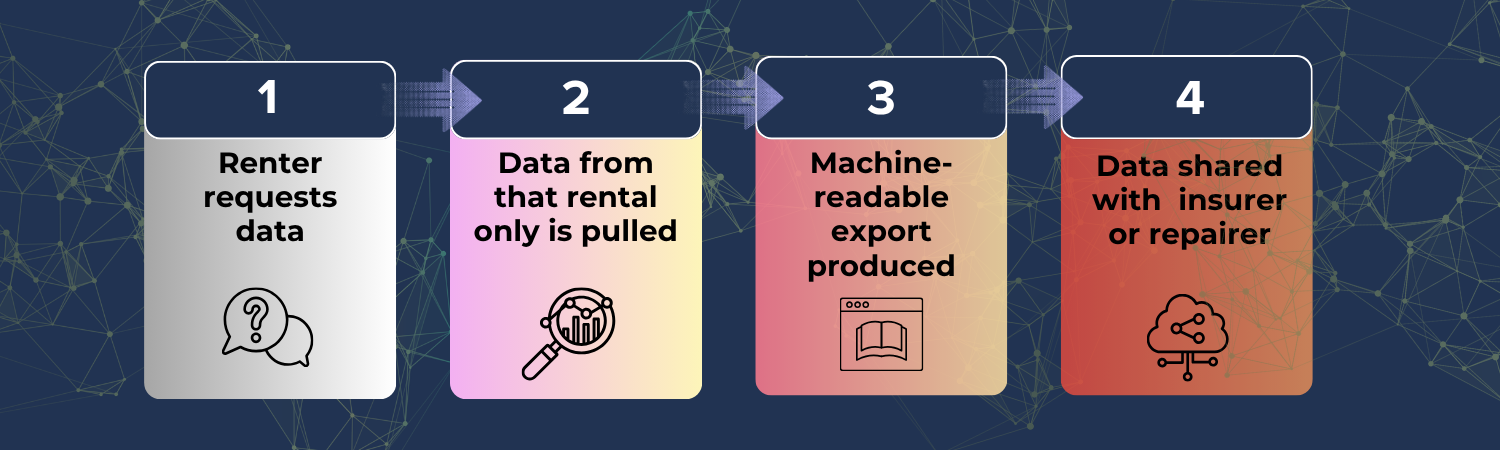
The EU Data Act – Regulation (EU) 2023/2854 – has applied since 12 September 2025, and it is the single biggest change to how rental operators in Europe must handle vehicle data. It treats the renter of a connected vehicle as a user of that product. Users have the right to access the data generated while they use it, receive it in a commonly used, machine-readable format, and share it with third parties such as an insurer, a lawyer or a repair shop.
Two obligations land directly on rental companies:
- Transparency before the contract. Article 3 requires anyone who sells, rents or leases a connected product to tell the user, before the agreement is signed, what data the vehicle generates, in what format and volume, and how to request it. Some of Europe’s largest rental brands have already published Article 3(2) notices listing data such as mileage, driving time, fuel or battery level, location and maintenance alerts.
- Access on request. When a renter asks for the data from their rental, you need to be able to isolate exactly that rental window, export it cleanly, and hand it over without exposing the previous or next customer’s data.
A second milestone arrived on 12 September 2026: the access-by-design obligation. Connected products placed on the EU market after that date must be built so users can reach their data easily, securely and directly. In practice, the vehicles joining your fleet from now on are designed for data sharing – and renters will increasingly expect it.
This is where telematics does the heavy lifting. A rental-specific platform ties every data point to a rental agreement, so a renter’s request becomes a structured export rather than an engineering project. It also logs who requested what and when – which matters, because you may need to show a regulator how you handled each request.
What about the Digital Omnibus? The European Commission proposed amendments to the Data Act in November 2025 as part of its Digital Omnibus package. Legal commentators note that the proposal largely leaves the connected-product access rules intact, and advises businesses to keep complying with the Data Act as it stands today.
Go deeper on the EU Data Act here.

Recording Driving and Rest Time on Regulated Vehicles (Tachographs and ELDs)
If you rent or lease vans and trucks to business customers, hours-of-service rules are now your problem too – even when the legal duty sits with the customer driving the vehicle. Your renters need vehicles fitted with the right recording equipment, and you need to know which vehicles in your fleet qualify.
Europe: tachographs reach the van fleet. From 1 July 2026, vans and light commercial vehicles between 2.5 and 3.5 tonnes used for international transport of goods for hire or reward (or cabotage) must carry a second-generation Smart Tachograph (G2V2) and follow EU drivers’ hours rules. The rule applies regardless of when the van was registered, and tachograph and driver-card data must be kept for at least 12 months. UK operators are covered too for journeys between the UK and the EU; UK-only work is not affected.
United States: the ELD clean-up. The FMCSA’s electronic logging device (ELD) mandate hasn’t changed in substance, but enforcement has. The agency has declared dozens of ELD models non-compliant in 2026, and a driver using a revoked device is treated as having no ELD at all – an out-of-service violation. One relief for rental: a long-standing FMCSA exemption means drivers of property-carrying trucks rented for 8 days or less can use paper logs instead of an ELD, provided they carry the rental agreement. Rentals longer than that, or rolling 8-day renewals, need a registered ELD.
Canada: certified devices only. Canada’s federal ELD mandate has been enforced in most provinces since 1 January 2023. Unlike the US, Canadian ELDs must be certified by an accredited third party, and enforcement is carried out province by province.
Telematics helps on three fronts. It tells you which vehicles have compliant recording equipment fitted. Geofencing can flag a van crossing a border it isn’t equipped to cross. And rental-length data lets you spot when a “short-term” truck rental has quietly become a long-term one that needs an ELD.


Tracking Vehicles Only When the Law Allows (California, US State Privacy Laws and Canada)
Compliance isn’t only about collecting data. In North America especially, it’s just as much about not using it when you’re not allowed to.
California sets the strictest rental-specific rules. Under Civil Code Section 1939.23, a rental company generally cannot use information about a renter’s use of the vehicle that was gathered through electronic surveillance technology. The exceptions are narrow: locating a vehicle that is stolen, abandoned or missing (including one not returned 24 hours after the agreed time, with notice to the renter), responding to a subpoena or search warrant, or an AMBER Alert. Telematics can still record departure and return times, total mileage and fuel level. What it can’t do is track renters in order to charge them fines or surcharges for how they drove. Companies must also keep a record whenever surveillance technology is activated.
AB 1197 widened the door – slightly. Signed in October 2025 and in force from 2026, AB 1197 lets California rental companies use geofences to detect two specific events: a vehicle leaving the country when the rental agreement doesn’t allow it, and a vehicle being moved into an impound or tow yard. The renter must be notified of an impound detection, and if the vehicle stays there for 24 hours after that notice, it is deemed abandoned. The same law tightened theft liability: a renter’s presumption of non-liability now requires returning the ignition key and filing a police report within 24 hours.
Location data is “sensitive” almost everywhere else. Across US states with comprehensive privacy laws, precise geolocation is classed as sensitive personal data. Virginia banned the sale of precise geolocation data from 1 July 2026, Oregon and Connecticut have similar bans, and Maryland now defines precise geolocation as anything locating a person, device or vehicle within 1,750 feet. Enforcement is real: in May 2026, California regulators announced a $12.75 million settlement with an automaker accused of selling drivers’ location and driving data to data brokers.
Canada adds its own layer. Federal privacy law (PIPEDA) requires meaningful consent, while Quebec’s Law 25 goes further, with express consent requirements and privacy impact assessments when personal information leaves the province. In the EU, the GDPR applies alongside the Data Act, so location data from a rental is personal data either way.
The operational answer is a telematics platform that is jurisdiction-aware. That means tracking rules that differ by location, geofences configured to match what local law permits, location data that stays dormant during a rental unless a lawful trigger fires, and a clear record of why it was accessed. The geofencing that protects your fleet in one market has to be set up differently in another.
 Proving It With Timestamped Audit Trails
Almost every regulation in this post shares one demand: show your workings. California requires a record of each time tracking is activated. EU tachograph data must be kept for at least 12 months. US ELD data has to be transferable to an inspector at the roadside. Data Act and GDPR requests need a record of who asked, what was supplied, and when. And when a vehicle is stolen or damaged, insurers and police want a timeline, not a reconstruction.
Manual processes struggle with all of this. Spreadsheets get overwritten, notes go missing, and nobody can say with certainty what happened at 2:14am on the night a vehicle left the depot.
Telematics turns compliance evidence into a by-product of normal operations. Every ignition event, geofence breach, data request and alert is logged automatically against a vehicle and a rental agreement, with a timestamp. When an auditor, insurer or regulator asks a question, the answer already exists. And when the platform feeds directly into your rental management system through an API integration, that record sits alongside the contract it relates to – not in a separate system someone has to search.
Good audit trails also protect you. In a theft or damage dispute, the operator with the cleanest data usually has the strongest position – a point we covered in another article: The 7 Real Costs of a Stolen Rental Vehicle.
 Future-Proofing Your Fleet Against Connected-Vehicle Rules
The next wave of regulation targets the vehicles and devices themselves, not just the data they produce.
United States: the connected vehicle supply-chain rule. A US Department of Commerce rule, in effect since March 2025, bans connected-vehicle software with a sufficient link to China or Russia from model year 2027, and connectivity hardware from model year 2030 (or 1 January 2029 for parts with no model year). It currently covers passenger vehicles under 10,001 lbs, and manufacturers and importers must file annual declarations of conformity. For rental operators buying model year 2027 vehicles right now, that rule already shapes which vehicles are available.
Europe: OEM data opens up. Under the Data Act, fleet owners have the right to access the data their own vehicles generate, which makes it easier to bring data from several manufacturers into one view. Combined with the September 2026 access-by-design rule, factory-fitted connectivity is becoming a realistic data source alongside aftermarket devices.
The practical move is to choose a telematics platform that works with both: OEM telematics where the manufacturer provides the data, and approved hardware where it doesn’t. Then, when rules change on either side, your compliance doesn’t depend on a single data source. It’s also worth asking your vehicle and device suppliers directly for their position on the US connected vehicle rule before your next fleet order.
| Regulation (region) | Key date | What telematics does |
|---|---|---|
| EU Data Act (EU) | 12 Sep 2025; access-by-design 12 Sep 2026 | Exports each renter's data on request |
| Smart Tachograph 2 for vans (EU, UK–EU) | 1 Jul 2026 | Flags equipped vans and border crossings |
| GDPR (EU) | Since 2018 | Limits and controls location data |
| FMCSA ELD mandate (US) | Revocations through 2026 | Spots truck rentals over 8 days |
| Civil Code 1939.23 + AB 1197 (California) | AB 1197 from 2026 | Tracks only when the law allows |
| State privacy laws (US) | Jan–Oct 2026 | Handles consent; no sale of location data |
| Connected vehicle rule (US) | Model year 2027 | Works across OEM and approved hardware |
| ELD mandate (Canada) | Since 1 Jan 2023 | Confirms certified devices |
| PIPEDA + Law 25 (Canada) | Law 25 since Sep 2023 | Records consent |
Compliance Is Now a Data Problem – And a Data Opportunity
Look across all five areas and the pattern is the same. Regulators want rental operators to share data when customers ask, record it when safety demands it, hold back when privacy requires it, and prove all of it afterwards. None of that is realistic with manual processes across a fleet of hundreds or thousands of vehicles.
Telematics doesn’t make you compliant on its own – your policies, contracts and legal advice still matter. But it gives you the infrastructure to meet these rules consistently, in every market you operate in. And the operators who get there first won’t just avoid fines. They earn renter trust, settle disputes faster and walk into insurance renewals with data on their side.
Note: This article is for general information purposes and does not constitute legal advice. Regulations change and vary by jurisdiction; please speak to a qualified adviser about your specific obligations.
Frequently Asked Questions About the role of Telematics in Compliance
-
Does the EU Data Act apply to car rental companies?
Yes. The EU Data Act applies to connected vehicles, and its transparency obligations under Article 3 apply to anyone who rents or leases a connected product. Rental companies must tell renters before the contract what vehicle data is generated and how to access it, and provide data generated during the rental on request.
-
What vehicle data can a renter request under the EU Data Act?
Renters can request readily available data generated while they used the vehicle, such as mileage, driving time, fuel or battery level, location and diagnostic alerts. It must be provided in a commonly used, machine-readable format and can be shared with third parties like insurers or repairers.
-
What changed for the EU Data Act on 12 September 2026?
The access-by-design obligation took effect. Connected vehicles and related services placed on the EU market after that date must be designed so users can access their data easily, securely and directly by default.
-
Do rental vans need a tachograph from July 2026?
Only some. From 1 July 2026, vans between 2.5 and 3.5 tonnes used for international transport of goods for hire or reward, or cabotage, in the EU, EEA, Switzerland or between the UK and EU must have a Smart Tachograph 2. Domestic-only use is not affected by this change.
-
Do rented trucks need an ELD in the United States?
Under a long-standing FMCSA exemption, drivers of property-carrying trucks rented for 8 days or less can use paper logs instead of an ELD (Electronic Logging Device) if they carry the rental agreement. Longer rentals, or repeated 8-day renewals of the same truck, require a registered ELD.
-
How does telematics help with regulatory compliance?
Telematics automates the data work regulations require: exporting rental-specific data for Data Act requests, identifying vehicles with compliant tachographs or ELDs, applying location-tracking rules by jurisdiction, and keeping timestamped audit trails for regulators, insurers and law enforcement.
-
Can rental car companies track vehicles with GPS in California?
Only in limited situations. California Civil Code 1939.23 restricts rental companies to using tracking data to locate stolen, abandoned or missing vehicles, respond to law enforcement, or record departure, return, mileage and fuel. Since AB 1197, geofences may also detect unauthorised international travel and vehicles entering impound or tow yards. Tracking to impose fines or surcharges is prohibited.